








Self-publishing a professionally prepared book usually costs about $2,000 to $6,000. A mostly DIY release can cost a few hundred dollars, while illustrated projects or premium launches can exceed $15,000. Reedsy’s current estimate falls between $2,940 and $5,660, although your manuscript’s needs determine the actual bill.
Uploading isn’t the expensive part. Getting your book ready can be.
An editing quote arrives. Then your designer asks about print formats. Suddenly, that modest publishing budget has several moving parts.
Look, you don’t have to buy every service available. You need to understand what your manuscript requires and which expenses can wait. Here’s how to put the numbers together without paying twice for the same work.
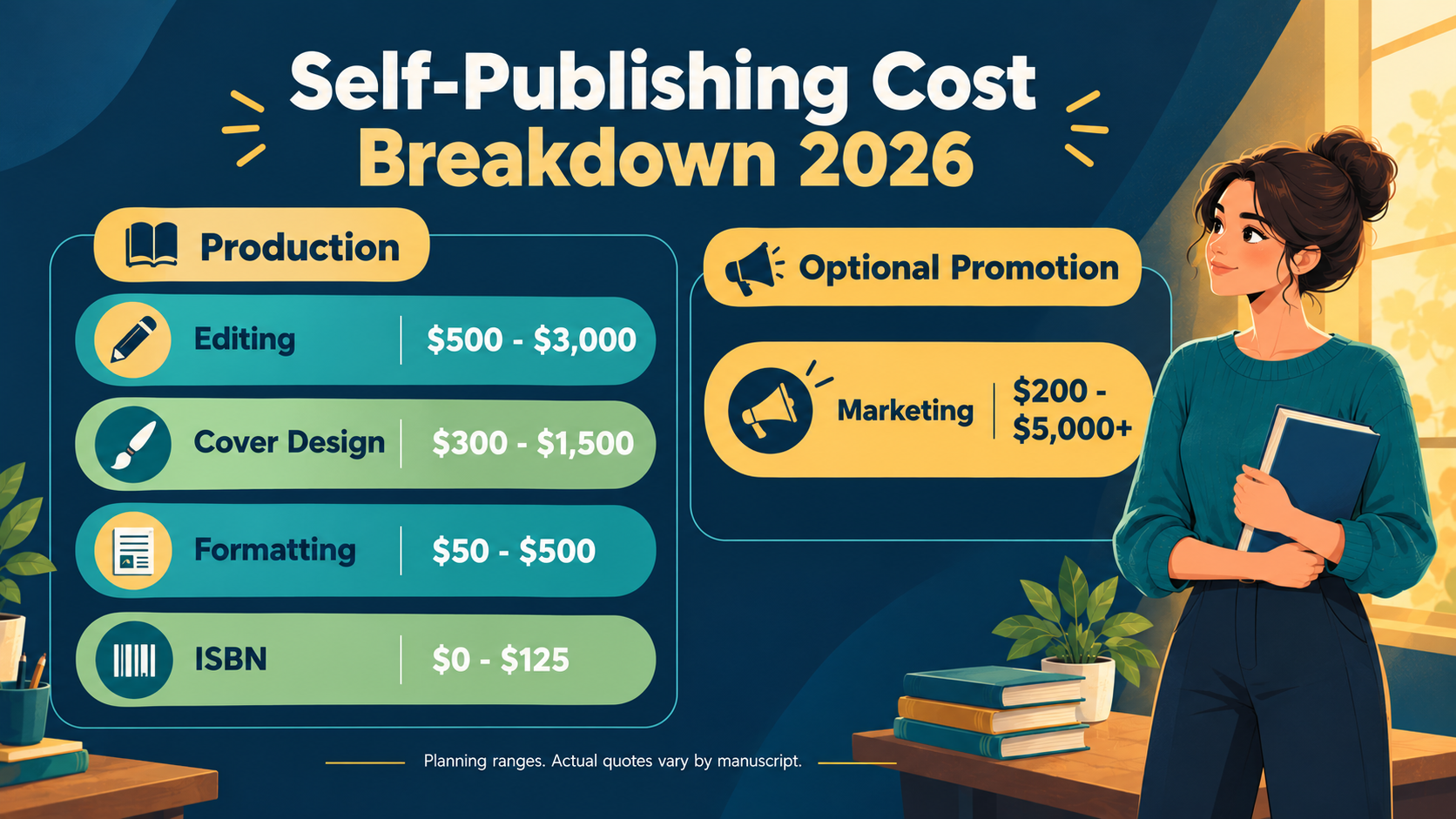
Your self-publishing cost depends on how much professional help the manuscript needs. A revised novella differs from an illustrated reference book. Use the following figures as planning allowances, not fixed quotations. The total row describes an overall budget rather than another charge to add above everything else.
| Item | Typical Planning Range | What to Watch |
|---|---|---|
|
Editing |
$500 to $3,000 for shorter books or selected services |
Long manuscripts and multiple editing stages can cost more |
|
Cover design |
$300 to $1,500 |
Illustration and additional formats increase scope |
|
Formatting |
$50 to $500 for straightforward outsourced work |
Complex interiors can exceed this range; DIY tools may be free |
|
ISBN |
$0 through an eligible platform option or $125 for one purchased ISBN |
Separate print formats generally need separate ISBNs |
|
Marketing |
$200 to $5,000+ |
Set a spending limit rather than treating this as mandatory |
|
Full professional self-publishing |
About $2,000 to $6,000 |
Premium production or a larger launch can exceed $15,000 |
These bands describe different project sizes. For comparison, Reedsy reports roughly $2,160 to $5,050 for editing an 80,000-word book and a $930 median cover price. Bowker lists one ISBN at $125.
Need the production sequence first? Read how to self-publish a book before booking services.
Most publishing budgets grow through individual decisions rather than one large purchase. Start with the manuscript itself, then price the work needed to make it ready for readers.
Editing often takes the largest share of your production budget. However, “editing” can describe very different assignments.
A structural review addresses the book’s larger problems. Copyediting checks sentence-level accuracy and consistency. Proofreading checks the finished layout.
Reedsy estimates approximately $2,160 to $5,050 for editing an 80,000-word manuscript, depending on the services purchased. Request a sample-based quote. A $500 allowance won’t buy the same work as several full-manuscript editing stages.
Your cover needs to signal the right kind of reading experience. Attractive artwork alone doesn’t settle that question.
Reedsy reports a $930 median cover price, with more than half of its collaborations between $630 and $1,200. A simpler design from a newer professional may cost less. Before paying, confirm whether the quote includes print artwork and permitted image use. Ask about revision limits and source-file delivery too.
Formatting prepares your manuscript for its reading format. An ebook needs working navigation. A printed edition needs a correctly arranged page layout.
Free tools can handle many text-heavy books. Specialist interiors cost more. Reedsy reports that around half its professional interior-design projects fall between $475 and $1,275. A $50 to $500 allowance therefore suits simpler assignments, not every book. Request separate deliverables for EPUB and print-ready PDF files.
An ISBN identifies a particular edition and format. It doesn’t register copyright or pay for distribution.
KDP offers free ISBNs for eligible paperbacks and hardcovers. Those numbers work only through KDP. Buying your own allows use across publishing services, subject to matching edition details.
Bowker lists one ISBN at $125 or ten at $295. Don’t buy a block automatically. Count the formats and future titles you genuinely expect to publish.
Marketing is a spending decision, not an admission ticket to publishing. You can begin with direct outreach and unpaid promotional work.
Paid activity needs a clear limit. Reedsy discusses marketing budgets of $60 to $1,500, although broader campaigns can cost more. Separate advertising spend from a marketer’s management fee. Otherwise, a quoted “campaign budget” may leave you wondering how much actually reaches readers. Ask for that split before approving anything.
Yes, you can publish through Amazon KDP without paying an upload fee. That doesn’t mean professional preparation costs nothing. You might use free formatting software and create your own cover. However, you’ll supply the labor yourself and take responsibility for checking the finished book before readers buy it.kdp.amazon+1
Free publication is possible. Free preparation depends on your skills and available time.
Two authors can publish through the same platform and spend very different amounts. The difference usually starts with the manuscript, then grows through format choices and production decisions.
More words generally mean more editorial work. Still, word count doesn’t tell the whole story.
A clean 70,000-word manuscript may need fewer interventions than a confused 40,000-word draft. Reedsy identifies manuscript conditions alongside length as a pricing factor. Finish your own revisions before requesting final quotes. Then ask the editor what problem each proposed service solves. Don’t buy several editing labels simply because they appear together in a package.
A plain-text novel creates different production demands from a cookbook. Recipes may need fixed layouts. A technical handbook may require diagrams and a detailed index.
Those tasks add skilled work beyond arranging paragraphs. Reedsy notes that specialist formatting and illustration can increase costs substantially. Send sample pages when requesting quotes. A designer can price an actual layout more accurately than a description saying the book contains “a few pictures” throughout.
An ebook and paperback don’t use identical production files. Adding a hardcover creates another set of specifications.
Reedsy notes that extra formats can increase cover-design costs. Print editions need spine and back-cover work beyond an ebook’s front image. Start with the formats your readers are likely to buy. You can add another edition later. There’s little sense funding several versions immediately if your budget barely covers the first one properly.
Moving a chapter after formatting can create avoidable work. So can changing the title after approving cover files.
Think of production as building on wet cement. Alter the base and later work may need repairs. Ask providers when changes become billable. Approve the manuscript before final layout work begins. Then leave time to inspect proofs without rushing decisions. Your contract should explain the price of extra rounds rather than leaving both sides guessing.
Want help sorting necessary work from optional extras? Get Started with MacLean’s Publisher or call +1 805-285-2038 to discuss your manuscript.
Traditional publishing usually costs the author less upfront because the publisher funds production. Self-publishing places that responsibility with you. However, the routes also divide control and earnings differently. Compare the actual terms rather than assuming that a higher royalty percentage automatically leaves more money in your pocket.
| Factor | Self-Publishing | Traditional Publishing |
|---|---|---|
|
Required author-funded production |
Commonly about $2,000 to $6,000 for professional preparation |
Generally $0 under a conventional publishing agreement |
|
Royalty examples |
KDP ebooks offer 35% or 70%, subject to eligibility and deductions |
Hardcover contracts commonly use 10% to 15% of list price; terms vary |
|
Planning timeline |
Allow roughly 3 to 8 months for a revised manuscript, depending on scope |
Allow roughly 18 to 36 months after acquisition; schedules vary |
|
Production decisions |
You manage them or hire support |
The publisher manages them under the contract |
|
Financial exposure |
You fund services before knowing sales results |
The publisher carries production costs; optional personal spending may remain |
The royalty examples use different formats and calculation bases. They aren’t like-for-like take-home earnings. KDP paperback royalties instead use 50% or 60%, with printing costs deducted. Traditional ebook terms commonly differ from hardcover terms.kdp.
The timeline figures are planning allowances, not promises. Finding an agent or publisher can add substantial time before acquisition.
A sensible budget protects the work readers will notice without funding every possible extra. Put each purchase against a specific need before you approve the next payment request.
Deal with large revisions before buying final formatting. Otherwise, you may pay someone to lay out pages that soon disappear.
Use early readers to identify confusing passages. Then revise before requesting professional help. Reedsy recommends preparing the manuscript before handing it to an editor. That doesn’t replace editorial judgment. It gives the editor a cleaner starting point. You’re paying for skilled attention rather than avoidable cleanup across an unfinished draft.
A cheaper package may exclude the very task you need. A larger package may include work you can handle yourself.
Ask every provider to quote against the same project description. Include word count and intended formats. Then compare revision limits and file ownership.
A coordinated Book Publishing Services arrangement can group production tasks. Still, request an itemized proposal. Convenience should make the bill easier to understand, not harder to examine.
Don’t let advertising quietly consume money reserved for finishing the book. Set a production ceiling first. Then decide what you can afford to test after release.
Here’s a hypothetical calculation: a $3,000 investment requires 750 sales if each sale leaves $4 before other expenses. That isn’t a forecast. It’s a budgeting check. Additional advertising increases the amount you must recover. Use your own expected royalty rather than borrowing another author’s figures.
The last stretch can produce small bills with awkward timing. Proof copies and shipping are common examples.
Reedsy suggests allowing approximately $10 to $100 for proofs, depending on order size and shipping. Also ask what happens if a proof reveals a layout problem. Is the correction included? Keep a modest reserve instead of assigning every dollar early. A budget with breathing room makes final decisions much less stressful when publication approaches.reedsy
For the bigger route comparison, read how to publish a book before committing to a production agreement.
Self-publishing doesn’t require buying the biggest package on the page. It requires paying for the work your book actually needs.
Start with the manuscript. Price each service against a clear scope. Then keep launch spending separate from production.
You’ll make better decisions when every charge has an explanation.
Ready to build a realistic publishing budget? Get Started with MacLean’s Publisher or call +1 805-285-2038 to discuss your manuscript and preferred formats.
Subscribe to receive our latest publishing insights and author guides.