







Book editing can cost $500 to $3,000 for a shorter manuscript or selected editing services. Longer books often cost more. Using the Editorial Freelancers Association’s fiction rates, an 80,000-word copyedit costs approximately $1,600 to $2,160. Several editing stages require separate budgets unless your agreement explicitly combines them.
Book editing can cost $500 to $3,000 for a shorter manuscript or selected editing services. Longer books often cost more. Using the Editorial Freelancers Association’s fiction rates, an 80,000-word copyedit costs approximately $1,600 to $2,160. Several editing stages require separate budgets unless your agreement explicitly combines them.
The tricky part? Two quotes labeled “book editing” may cover completely different work.
One editor might review your chapter structure. Another might correct punctuation without touching the storyline. Neither quote tells you much until you know what happens to the manuscript.
Here’s how to compare editing costs without buying the wrong service.
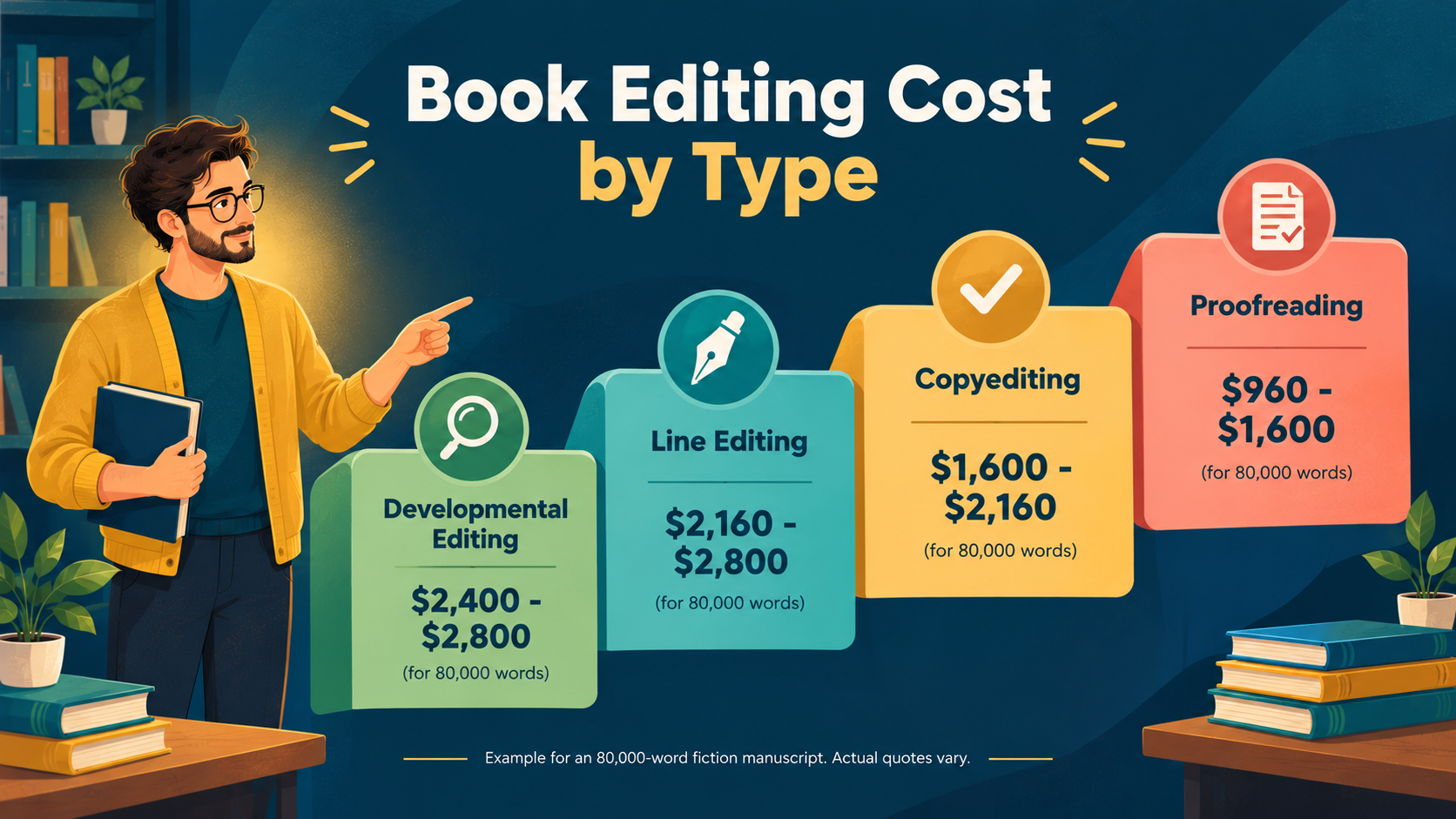
Your book editing cost depends on the work involved and the manuscript’s length. A short, revised ebook won’t require the same budget as a full-length novel needing structural changes. Use the smaller-project allowances below cautiously. They aren’t promises and the lowest figures don’t represent full-length book averages.
| Editing Type | What It Addresses | Illustrative Shorter-Project Budget | 80,000-Word Fiction Example |
|---|---|---|---|
|
Developmental editing |
Structure, including plot or argument |
$1,000 to $3,000+ |
$2,400 to $2,800 |
|
Line editing |
Sentence flow and expression |
$500 to $2,000 |
$2,160 to $2,800 |
|
Copyediting |
Grammar and consistency |
$400 to $1,500 |
$1,600 to $2,160 |
|
Proofreading |
Remaining errors in the finished text and layout |
$200 to $800 |
$960 to $1,600 |
The final column applies EFA’s 2026 fiction per-word ranges to 80,000 words. The shorter-project figures are preliminary allowances for varying lengths or limited assignments, not EFA survey averages.
For a closer look at the work itself, read our guide to the types of book editing.
Before comparing prices, identify the problem you’re paying someone to solve. These editing stages work at different levels, although an editor’s proposal may combine some tasks within one assignment.
Developmental editing looks at the book’s underlying construction. In fiction, that includes character motivation and pacing. In nonfiction, it may involve the argument and chapter order.
The EFA lists fiction developmental editing at $0.03 to $0.035 per word. Nonfiction runs $0.04 to $0.05. At 80,000 words, that means $2,400 to $2,800 for fiction or $3,200 to $4,000 for nonfiction. Ask whether the fee includes manuscript comments alongside an editorial letter.
Line editing works inside the paragraphs. An editor examines how your language carries meaning and where the reader might stumble.
Suppose a tense scene pauses for lengthy explanations. A line editor may tighten those interruptions while preserving your voice.
EFA fiction rates run $0.027 to $0.035 per word. Nonfiction rates are $0.035 to $0.05. Confirm whether grammar corrections form part of that service or require a separate copyedit afterward.
Copyediting checks accuracy and consistency at sentence level. That can include grammar, punctuation and spelling choices throughout the manuscript.
For example, your character shouldn’t have gray eyes in one chapter and green eyes later without explanation.
EFA rates for fiction copyediting run $0.02 to $0.027 per word. Nonfiction runs $0.03 to $0.04. Ask whether your editor supplies a style sheet recording decisions such as capitalization and preferred spellings for recurring terms.
Proofreading is the final check, not a substitute for earlier editing. It catches remaining mistakes after the text has reached its finished form.
A proofreader may notice a missing word or an incorrect running header. Rewriting weak chapters usually sits outside that assignment.
EFA fiction proofreading rates run $0.012 to $0.02 per word. Nonfiction rates are $0.02 to $0.03. For print, clarify whether the editor checks the laid-out pages rather than only the manuscript.
Still building your overall budget? Compare these expenses with our guide to how much it costs to self-publish a book.
Editors may charge by word count, time or agreed project scope. The pricing method matters less than understanding exactly what the fee covers and when additional charges apply.
Per-word pricing gives you a straightforward calculation: multiply the manuscript’s word count by the agreed rate.
A hypothetical 60,000-word copyedit at $0.025 per word costs $1,500. That rate falls within EFA’s fiction copyediting band.
Watch the decimal. Two cents means $0.02, not $0.20. Also confirm whether the quote uses your submitted word count or a later version. That small detail can change the bill after substantial revisions.
Hourly pricing connects the invoice to time spent. It can suit uncertain assignments, provided both sides agree on spending boundaries.
EFA lists fiction copyediting at $40 to $50 per hour. Its fiction developmental range is $52.50 to $70. The hourly figure alone won’t predict the total. Request estimated hours and a cap. Ask the editor to seek approval before exceeding it. That keeps a flexible arrangement from becoming an open-ended bill.
A fixed fee can make planning easier because the agreement names the assignment and its price. However, the scope needs clear boundaries.
Look for the manuscript length and service description. Then check revision allowances and delivery dates. Ask what happens if you replace chapters after editing starts. “One complete edit” leaves room for disagreement. A written list of deliverables gives both sides something concrete to refer to when questions arise.
Unsure which editing stage comes first? Get Started with MacLean’s Publisher or call +1 805-285-2038 to discuss your draft.
Word count matters, but it doesn’t explain every price difference. The EFA identifies several influences on rates, including work type, turnaround time and the editor’s experience level.
Every additional chapter adds material the editor must read and assess. That makes word count a useful starting point for comparing quotes.
At a hypothetical $0.03 per word, a 40,000-word assignment costs $1,200. An 80,000-word assignment costs $2,400.
Still, don’t cut useful material just to lower the invoice. Remove repetition during your own revisions. Then send the editor a stable version rather than a manuscript that keeps growing during the quotation process.
A manuscript with unresolved structural problems needs different help from a polished draft. Paying for surface corrections too early can mean paying again after rewrites.
Ask the editor to examine representative pages before recommending a service. Include a difficult chapter, not only your strongest opening. You want an accurate assessment. A flattering quote based on unusually clean pages won’t help if the remaining manuscript requires substantially heavier work than either person expected.
Specialist material can require an editor familiar with its conventions. A medical handbook and a romance novel don’t ask the same questions of their readers.
The EFA separates rates by genre and subject area, including technical work and memoir. Seek relevant experience rather than the broadest service list. Also ask whether factual verification is included. Copyediting a claim doesn’t automatically mean checking the evidence behind it or investigating its original source independently.
A compressed schedule can affect availability and price. The EFA identifies turnaround time as one factor behind rate differences.
Ask about scheduling before promising yourself a publication date. Then clarify what happens after you review the edited manuscript. Does the fee include answering queries? Will the editor check your revisions? An extra pass may be useful, but it should have an agreed purpose and price before either side starts that additional work.
If the draft still needs substantial writing, review how much a ghostwriter costs before budgeting for final-stage editing.
Not every manuscript needs four separately purchased services. Some editors combine line editing with copyediting. Other drafts need structural work before sentence-level attention makes sense. Start with a sample review or manuscript assessment when the next step feels unclear. Buy help for the problem you have, not a package label.
For the next stage, read how to publish a book and place editing within your wider production plan.
The lowest quote isn’t automatically the best deal. Neither is the largest package.
Start by identifying what your draft needs. Then compare proposals with matching word counts and clearly defined deliverables. Ask about follow-up questions before you commit.
You’re paying for considered attention, not simply fewer red marks.
Ready to discuss your manuscript? Get Started with MacLean’s Publisher or call +1 805-285-2038 for a conversation about the editing stage that fits your draft.
Subscribe to receive our latest publishing insights and author guides.