








DIY book marketing can cost under $200, while outsourced campaigns can run $500 to $5,000 or more. Those are planning bands, not fixed market averages. As one benchmark, lists advertising management at $500 to $1,000 monthly, excluding ad spend. Your total depends on scope and duration.
DIY book marketing can cost under $200, while outsourced campaigns can run $500 to $5,000 or more. Those are planning bands, not fixed market averages. As one benchmark, lists advertising management at $500 to $1,000 monthly, excluding ad spend. Your total depends on scope and duration.
That last distinction matters. A $700 management fee doesn’t necessarily include a dollar of advertising.
Picture an author approving a launch package, then discovering the campaign needs another advertising budget. The quote wasn’t necessarily misleading. It simply wasn’t clear enough.
Let’s separate the expenses. You’ll see what different channels require and how to judge spending against actual author earnings.
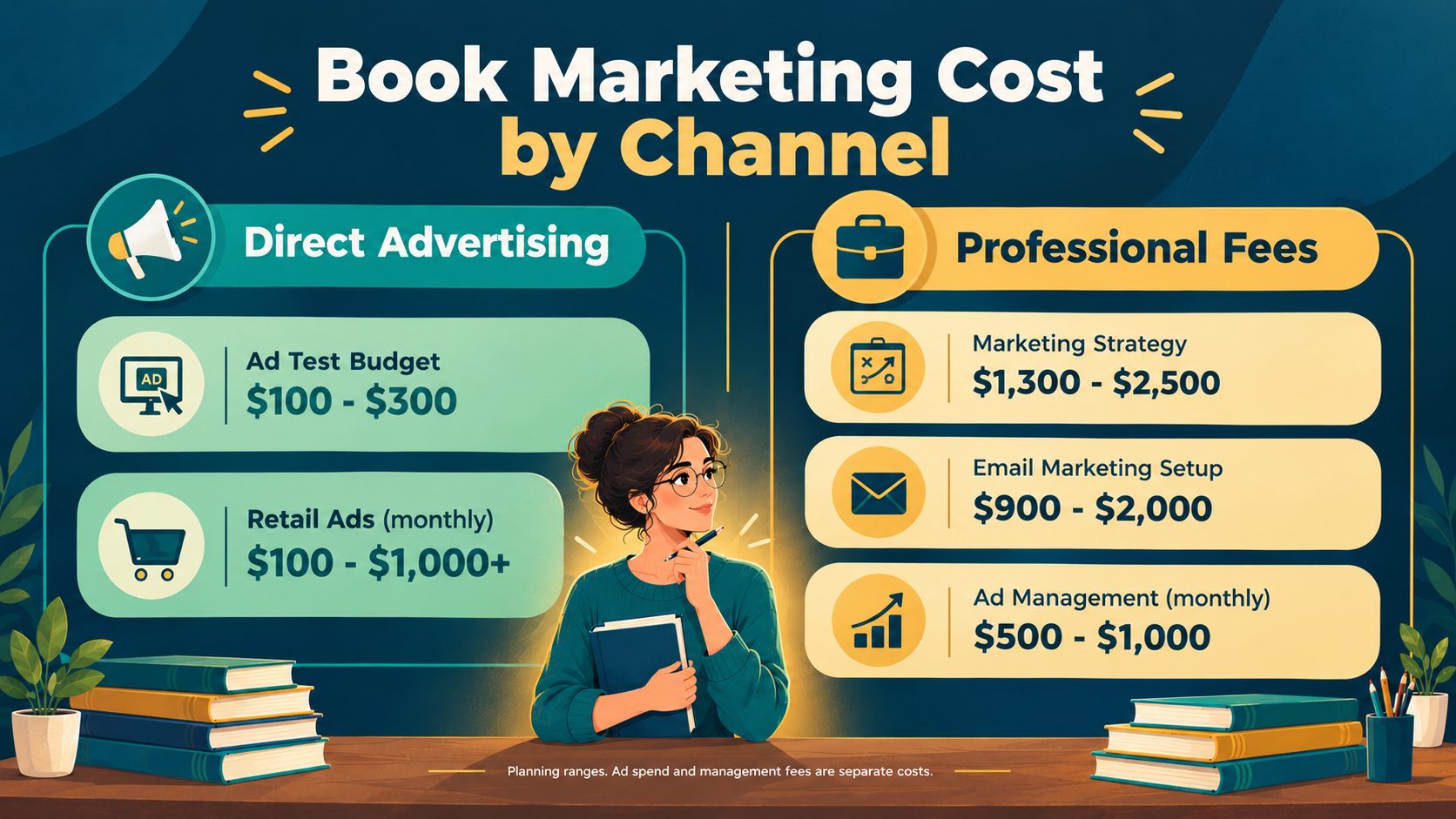
Your book marketing cost starts with the work you choose to do yourself. Posting an excerpt costs little beyond time. Hiring someone to manage advertising adds professional fees before the ads run. Keep one-time project charges separate from monthly costs so you can compare proposals without mixing different services.
| Channel | Practical Planning Allowance | What the Amount Covers |
|---|---|---|
|
Advance reader copies and reviewer outreach |
Low cash cost, plus your time |
Copies, delivery, and optional distribution tools |
|
Organic social media |
Little or no cash spending when self-managed |
Your own content creation and conversations |
|
Amazon or other retail advertising |
$100 to $1,000+ per month as a chosen test budget |
Advertising spend, not necessarily management |
|
Email marketing software |
$0 to $50+ per month as an early-stage allowance |
Provider access; subscriber limits and features vary |
|
Outsourced marketing |
$500 to $5,000+ per defined project or campaign |
Scope varies substantially; a small assignment isn’t a full launch |
These are budgeting allowances, not published averages for every channel. For a professional benchmark, marketing service guide lists strategy projects at $1,300 to $2,500 and advertising management at $500 to $1,000 monthly.
Need the practical starting steps? Read how to market a book before choosing paid support.
Each channel asks for a different investment. Some consume time rather than cash. Others combine software charges with professional fees, so the headline price rarely explains everything involved.
An advance reader copy, or ARC, lets someone read your book before release. Your expenses may include printed copies and delivery.
Digital copies can reduce distribution costs. However, finding suitable readers still takes work. Build a list of reviewers who already cover your genre. Offer the book without buying praise or demanding coverage.
Track your spending separately from responses. Sending fifty copies doesn’t mean fifty reviews will appear on publication day.
Organic social media can begin without paid software. Your main investment is the time needed to create useful posts and answer readers.
A mystery author might introduce a suspicious character. A gardening writer could demonstrate something from the book. Both give readers a reason to investigate.
If you outsource, ask what “social management” includes. Publishing scheduled posts differs from creating original material. Also clarify whether answering comments belongs to you or the provider.
Amazon Sponsored Products uses cost-per-click pricing. You pay when someone clicks, rather than simply when the advertisement appears. Your bids and budget influence spending.
For planning, $100 to $300 can be a small initial allowance, not a promise of meaningful sales. Choose an amount you can afford to lose while testing.
Amazon’s author advertising guide to understand the budget controls. Keep advertising spend separate from any specialist’s management invoice.
Email costs have two parts: the software and the work behind the messages. A free plan may suit a small list, but check its current subscriber and sending limits.
Professional setup is a different purchase. lists email marketing projects at $900 to $2,000. That might address list setup or automated messages rather than ongoing newsletter writing.
Ask who owns the account. You should retain access to your subscriber list and campaign records.
Publicity involves pitching a relevant story to media contacts. It isn’t the same purchase as advertising space.
Ask the publicist what the fee buys. You might receive a media pitch and targeted outreach. An appearance itself may remain outside their control.
lists book publicity among its marketing services but doesn’t publish a universal price on its main marketing page. Request a project-specific quote. Don’t build your budget around an unsupported promise of major coverage.
Still allocating your launch funds? Compare promotion with how much it costs to self-publish a book.
The real choice isn’t “free” versus “paid.” It’s deciding which work you can do well and where outside help fills a genuine gap in your current publishing plan.
DIY can suit authors with more available time than cash. You can contact suitable reviewers and maintain an email list yourself.
Start small. Choose a repeatable activity connected to your readers rather than opening accounts everywhere. A nonfiction author might send a useful monthly email. A novelist could share short readings.
Keep a simple record of effort and results. If one activity consumes hours without producing useful reader interest, reconsider it before adding more work.
Outside help can make sense when a specific skill gap blocks progress. Perhaps you need an advertising specialist or someone to build an email sequence.
separates these assignments rather than treating all marketing as one product. Its strategy and email services also carry different guide prices.
Buy a defined assignment first. Ask for relevant experience and clear reporting. No provider should need to promise bestseller status to explain the work you’re purchasing.
Not sure which tasks belong in your campaign? Get Started with MacLean’s Publisher or call +1 805-285-2038 to discuss your book and spending limit.
A larger budget doesn’t automatically produce a better campaign. Costs depend on the assignment and how long it runs. These factors help explain why otherwise similar proposals differ.
A launch project and ongoing management create different bills. One might finish after delivery. The other keeps generating monthly charges.
Suppose a specialist charges a hypothetical $600 monthly management fee. Three months costs $1,800 before advertising. That rate sits within ’s published management range.
Ask about the minimum term and cancellation notice. Then calculate the full commitment. A manageable first invoice can hide a much larger obligation when you overlook the agreement’s duration.
Every additional channel creates another assignment to manage. Ad platforms may need different creative work and separate reporting.
says its advertisers typically charge $500 to $1,000 per platform each month, beyond ad spend. That makes channel selection a financial decision, not merely a preference.
Begin where you have a clear reason to reach readers. Expanding everywhere at once makes it harder to identify what deserves continued funding and what should stop.
Advertising sends people somewhere. If the destination confuses them, more traffic won’t solve the underlying problem.
Check whether the cover matches the reading experience. Then review the description and available sample. A reader should understand what kind of book awaits.
This doesn’t mean endlessly delaying promotion. It means correcting obvious weaknesses before purchasing attention. Ask a few genre readers to inspect the listing. Their questions may reveal something you’ve stopped noticing after months with the manuscript.
Your affordable advertising cost depends on what a sale leaves you. Retail revenue and author royalties aren’t interchangeable.
A hypothetical $15 sale might leave only $4 in royalties after applicable deductions. Spending $6 to acquire that sale loses $2 before management fees.
A series author might also consider later purchases. However, don’t assume those purchases will happen. Base the calculation on observed results. Otherwise, imagined future income can become an excuse for ongoing losses.
A smaller budget needs a narrower job. Instead of trying everything, decide what you want to learn or achieve, then purchase only the work that supports that purpose.
Choose the amount you can commit without borrowing from necessary production work. Then divide it between direct campaign costs and outside help.
Keep a reserve. A proof-copy order or corrected promotional file can arrive at an awkward moment.
If professional support is on your list, ask a Book Marketing Agency for an itemized scope. You need to know what stops when the agreed budget runs out, not discover it after spending begins.
Choose one advertising platform and define the test before launching. Write down the spending ceiling alongside your review date.
Amazon lets authors control bids and budgets for Sponsored Products. Those controls help manage exposure, but they don’t guarantee profitability.
Keep the first assignment simple enough to interpret. If you change the audience and advertisement simultaneously, you may struggle to explain the outcome. Record what changed so the next decision has a useful starting point.
Here’s a hypothetical campaign:
The campaign generated purchases. It still lost money. At that royalty, $120 requires forty sales just to cover advertising.
Management fees would increase the break-even point. Use this calculation before raising the budget. A dashboard showing activity doesn’t settle whether the activity pays for itself.
Decide what a useful report must show before hiring anyone. At minimum, ask for spending and the outcomes tied to the assignment.
For advertising, examine attributed sales alongside estimated royalties. For publicity, review the outreach delivered and confirmed responses. Don’t judge every channel using the same measure.
Then ask what changes next. Renewal should follow a reasoned decision, not simply another invoice. If the explanation remains vague, request clarification before extending the agreement or increasing spend.
If readers mention distracting mistakes, review how much book editing costs before purchasing more traffic.
Your marketing budget doesn’t need to impress anyone. It needs to make sense.
Separate professional fees from advertising. Choose channels for a reason. Then review the result before extending the commitment.
For the wider production picture, read how to publish a book.
Ready to plan your next step? Get Started with MacLean’s Publisher or call +1 805-285-2038 to discuss promotion built around your book and an agreed spending limit.
Subscribe to receive our latest publishing insights and author guides.