








Hiring a ghostwriter can cost $5,000 to $50,000 or more for a book. However, established professionals often charge $18,000 to $50,000 for nonfiction, according to Reedsy. Your final price depends on manuscript length, research, interviews and revisions. Shorter projects or limited writing support can cost less.
That’s a big spread. What separates a modest quote from one approaching a down payment?
Usually, it’s the work behind the words. One author arrives with organized chapters. Another brings decades of memories and a shoebox of notes. Both want a book. They’re buying very different amounts of help.
This guide explains the numbers, the trade-offs and the questions worth asking.
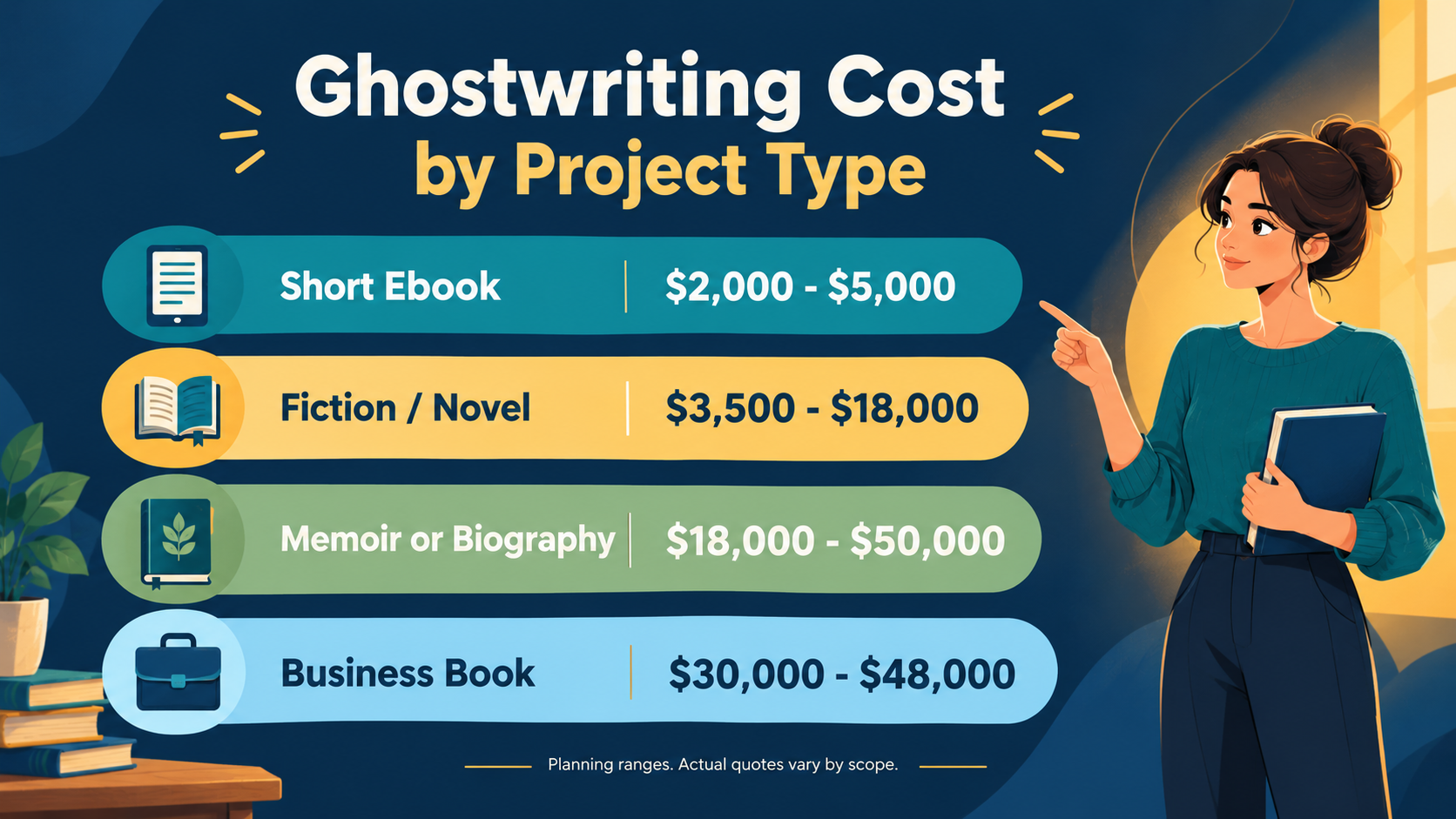
Your ghostwriting cost depends on the assignment, not simply the book category. A short manuscript built from prepared material needs less work than an interview-heavy biography. Treat the figures below as budgeting guides rather than fixed prices. Ask each writer to explain the scope behind their estimate.
| Project Type | Starting Budget or Limited-Scope Range | Established Professional Benchmark |
|---|---|---|
| Royalties | 70% | 10-15% |
| Time to Market | 1-2 Months |
$10,000 to $30,000 with a newer writer or narrower scope $18,000 to $50,000 Memoir or biography $5,000 to $12,000+ for shorter, limited-scope projects $18,000 to $50,000 Fiction or novel $15,000 to $50,000+ for substantial custom work Reedsy reports $3,500 to $18,000 across selected fiction categories |
Reedsy’s figures reflect its marketplace, not every provider. The lower planning bands above aren’t equivalent to its established-professional averages. Its current data also shows that fiction doesn’t automatically cost more than nonfiction.
A quote becomes easier to judge once you understand its pricing method. Writers may charge per word, hourly or through a fixed project fee with defined deliverables.
Per-word pricing connects the fee to manuscript length. Reedsy reports approximately $0.10 to $3 per word, with substantial differences between genres and experience levels.
For example, 40,000 words at $0.50 costs $20,000. That calculation doesn’t reveal everything, though. Ask whether the rate covers interviews, research, outlining and revisions. Also confirm whether billing follows the agreed target or the final accepted manuscript length.
Hourly arrangements can suit interviews, research or work on an existing draft. Reedsy reports rates of roughly $35 to $200 or more per hour.
The catch? Your final bill depends on time spent. Request estimated hours for each stage before work begins. Agree on a spending cap and progress reports. Otherwise, an apparently affordable hourly rate can produce an unexpectedly expensive manuscript.
For full books, Reedsy says professionals commonly quote a fixed project fee. That fee can cover research, drafting and agreed revisions. Extra work may attract separate charges.
This arrangement makes budgeting clearer when the scope stays stable. Your agreement should name the target length, interview allowance, deadlines and revision rounds. Ask what happens if you add chapters or change direction halfway through the draft.
Genre influences the assignment because different books demand different kinds of work. Still, length and preparation can matter more than the label printed on a proposal document.
A memoir requires more than arranging events chronologically. Your writer must identify the story connecting them. Interviews, family records and conflicting recollections can add substantial work.
Reedsy places professional biographies and memoirs at $18,000 to $50,000. A $5,000 to $12,000 offer may suit a shorter family-history project or narrower assignment. Don’t assume that price includes extensive interviews, archival research or a full-length commercial memoir.
A business book needs a clear argument, useful examples and credible supporting material. Your expertise supplies the substance. The writer helps readers follow and apply it.
Reedsy reports $30,000 to $48,000 for business and management books. Lower quotes may fit shorter manuscripts built from existing presentations or articles. Ask who handles research, permissions and checking factual claims before comparing one proposal against another.
Fiction pricing changes with length, genre and creative responsibility. A detailed outline reduces planning work. A single premise leaves character development, plotting and story decisions largely to the writer.
Reedsy reports $3,500 to $18,000 across selected fiction categories. Longer or more demanding assignments can attract higher quotes. For a series, ask whether the fee includes continuity notes, character records and planning for later books.
A focused ebook can offer a smaller starting commitment. For a straightforward 10,000 to 20,000-word project, use $2,000 to $5,000 as a preliminary planning allowance, not a market average.
That budget works best when you supply reliable source material. Interviews, technical research and repeated rewrites can push it higher. Define the reader’s problem first. A useful short book beats a longer manuscript padded to reach an arbitrary target.
Two books with identical word counts can require very different workloads. These four factors explain why a writer’s estimate may rise before drafting has even started on your manuscript.
Word count sets the size of the assignment. However, your starting material shapes how much discovery comes first.
Consider two hypothetical authors commissioning 50,000-word books. One supplies a detailed outline and recorded talks. The other has an idea but no supporting material. The second project needs more planning. Ask the writer which documents, recordings or draft sections could reduce that preparation work before they finalize their quote.
Experience affects more than sentence quality. A seasoned ghostwriter may spot weak arguments, missing scenes or unrealistic deadlines before they become expensive problems.
Reedsy identifies experience and genre as pricing factors. Still, a higher fee doesn’t prove a better fit. Request relevant samples where confidentiality permits. Discuss how the writer handles feedback. A paid sample chapter can help both sides test the working relationship before committing fully.
An interview-heavy book involves preparation, scheduling, transcription and follow-up questions. Research can also require document reviews, source checks or travel.
Reedsy identifies transcription and travel among possible additional expenses. Ask whether these costs sit inside the quote or outside it. For sensitive material, discuss recording storage and access. Your agreement should also say who approves interview expenses before anyone books travel or hires outside help for the project.
Feedback improves a manuscript when both sides know what the fee covers. Trouble starts when “revisions included” means different things to each person.
Ask for a clear revision policy. Does one round mean chapter-level comments or a full manuscript review? What happens after approval? Rewriting a passage differs from replacing the book’s central argument. Record these boundaries early so extra work requires written approval before billing begins.
Unsure which scope fits your manuscript? Get Started through MacLean’s Publisher or call +1 805-285-2038 to discuss your project.
Hiring help makes sense when the book serves a clear purpose and writing time remains scarce. Perhaps you want to preserve family memories or explain your business ideas. The fee buys skilled work and a defined process. It doesn’t buy guaranteed sales, publishing acceptance or personal recognition.
Build your budget around the manuscript you want delivered, not the smallest advertised package. Start with writing costs. Then identify research expenses, independent editing, design and publication work. Keeping those categories separate makes proposals easier to compare and helps prevent the same service appearing twice in your budget.
Planning beyond the manuscript? Read how to publish a book before committing your entire budget to writing.
The right quote explains what you’re buying. It names the manuscript length, research duties, revision allowance, payment milestones and ownership terms.
Start there. Then compare the writer’s experience and communication style against your goals. A lower price can suit a smaller project. A larger fee needs a clear explanation.
Ready to discuss your book? Get Started with MacLean’s Publisher or call +1 805-285-2038. Bring your idea, estimated length and available material to the conversation.
Subscribe to receive our latest publishing insights and author guides.